The Science of Resilience and Flexibility
Resilient is based on over a decade of research, leveraging over $30M in investment from Federal agencies including DARPA and NIH, private foundations, and the University of Minnesota. We have mapped the brain circuits that give rise to inflexible behavior, discovered how to improve their function, and built that discovery into an algorithm designed to deliver the right treatment for every patient, every time.
From Brain Circuits to Clinical Vision
01
Inflexibility (Loss of Resilience) Underpins Most Mental Disorders
One of the most common patient experiences, across illnesses, is being "stuck" in a pattern that they want to escape, but feel unable to. From the looping, ruminative thoughts of depression, to intrusive worries and avoidance in anxiety, to cravings in addiction that seem impossible to resist, people living with brain disorders say "I don't want to keep doing this, but I can't stop." Their brain has lost the ability to be flexible and shift into new habits and new paths.
02
Flexibility Circuits Converge In The Deep Brain's Internal Capsule

That ability to flexibly shift thought and behavior does not come from any one brain area. Instead, it arises from multiple brain regions connected to each other and constantly communicating. We identified a "hub" where those connections come together, near the center of the brain, as part of a "superhighway" of brain connections called the internal capsule.
03
Simple, Scalable Real-Time Flexibility Circuit Measurement

To use that hub to improve flexibility, we needed a way to tell how well the flexibility circuits are working, and to tell when they are changing. We identified a simple behavioral test, easily done on any laptop or tablet, where a person's speed (technically, their "trial response time") is a measure of how efficiently the brain can process evidence, identify and resolve conflicts, and shift between different responses (thoughts and behaviors) when needed.
04
Engaging and Enhancing Flexibility Circuits With Electrical Stimulation
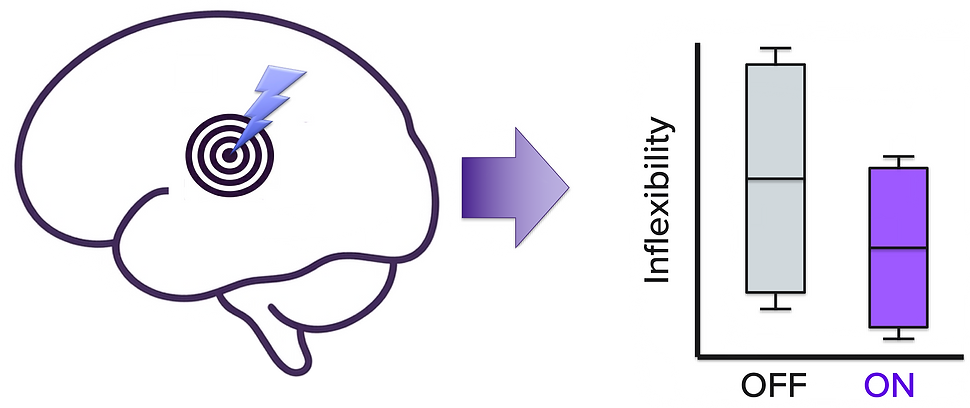
By delivering a small amount of electrical current into that internal capsule "hub", we affect the distributed brain network that drives mental flexibility. When the stimulation is tuned correctly, performance (speed on our real-time measurement) changes in a matter of seconds. That is, we can tell exactly when the therapy is tuned to engage the target, in every single patient. We replicated this exact effect across pre-clinical models and multiple cohorts of human volunteers. From there, we built custom algorithms that ensure the target is engaged every time, supporting clinicians in "tuning" therapy for their patients.

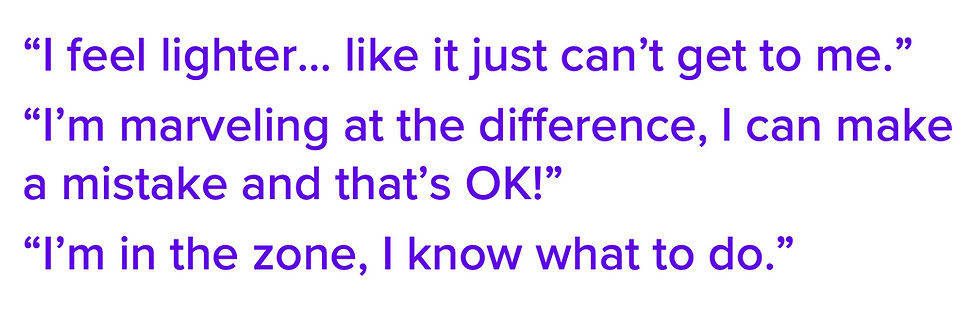
Across multiple experiments, when we enhance flexibility, people report feeling lighter, more focused, and more able to manage their own emotions -- they become more resilient.
05
06
The Road Less Traveled, The Road To Recovery

With that greater flexibility and reduced emotional burden, we believe that patients will be more able to make the changes they have wanted for their own lives -- to get "unstuck" and take control of their minds and their lives. Each day will be one small step on the road to recovery, but each day's small step is one step closer to the goal, and is a step they could not take before.